Write and refine the design
Decide what you’re building, and why, before anyone writes code.
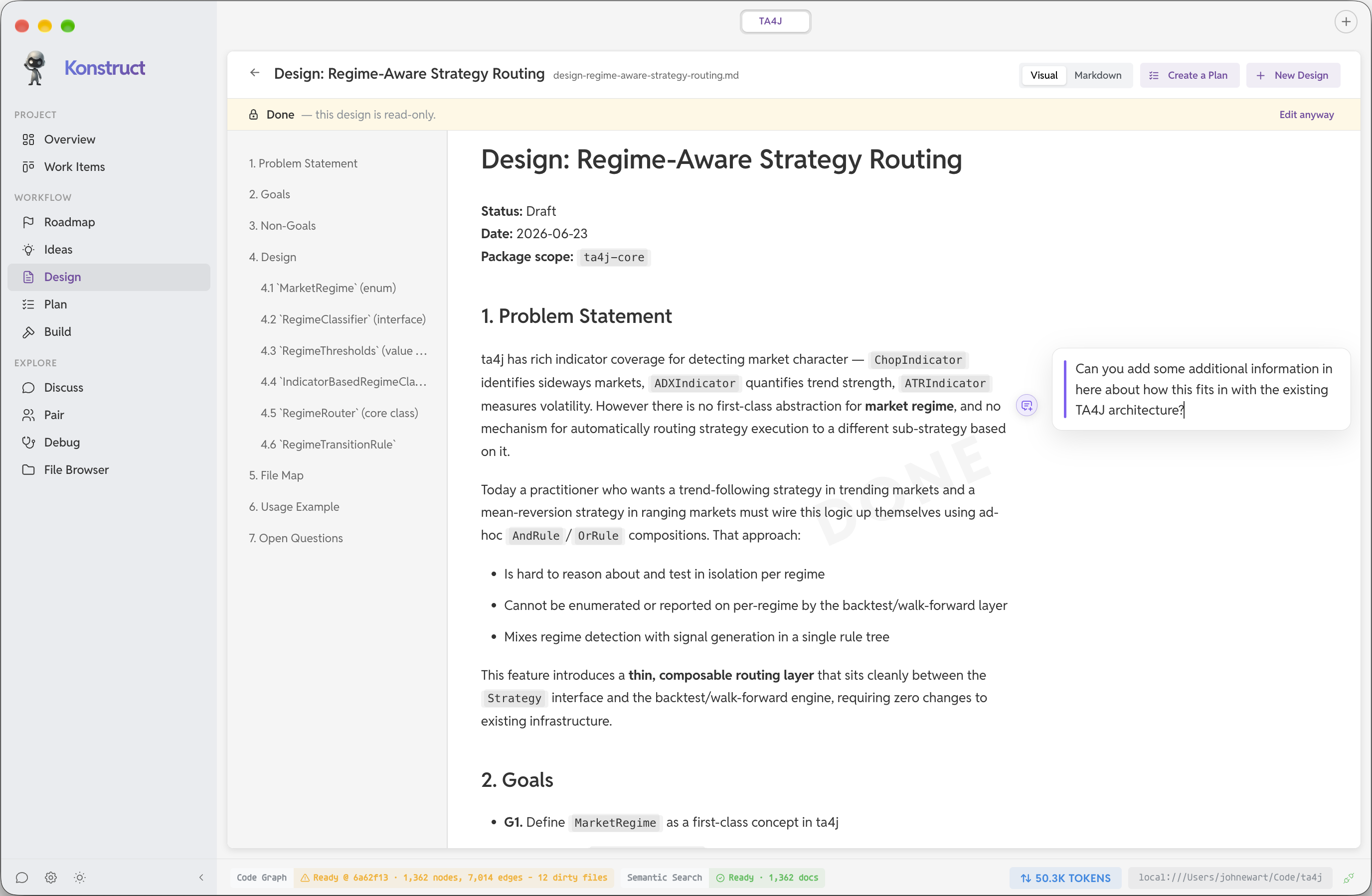
Most agent sessions start from a prompt, which means the first design decision gets made somewhere around the third file the model touches — by the model, silently, and usually in whatever direction the training data leaned. The Design agent pulls that decision forward into a document you can read and revise before any of it is binding.
It asks the questions a reviewer would: what problem is this solving, what is out of scope, what constraints does it have to live inside, and what did you reject on the way. You push back, it revises, and you do that until the document says what you meant. This is the cheapest place in the pipeline to change your mind.
It is also the place where the whole thing is most easily wasted. A vague design produces a vague plan, a vague plan produces a blueprint of vague phases, and a blueprint of vague phases produces an agent doing something adjacent to what you wanted for an hour. The time you spend here is the main lever you have on how the run turns out.
You end up with: a design document covering goals, constraints, boundaries, and the tradeoffs behind each call.
Plan it against your code
Work out how it gets built, here, in this codebase.
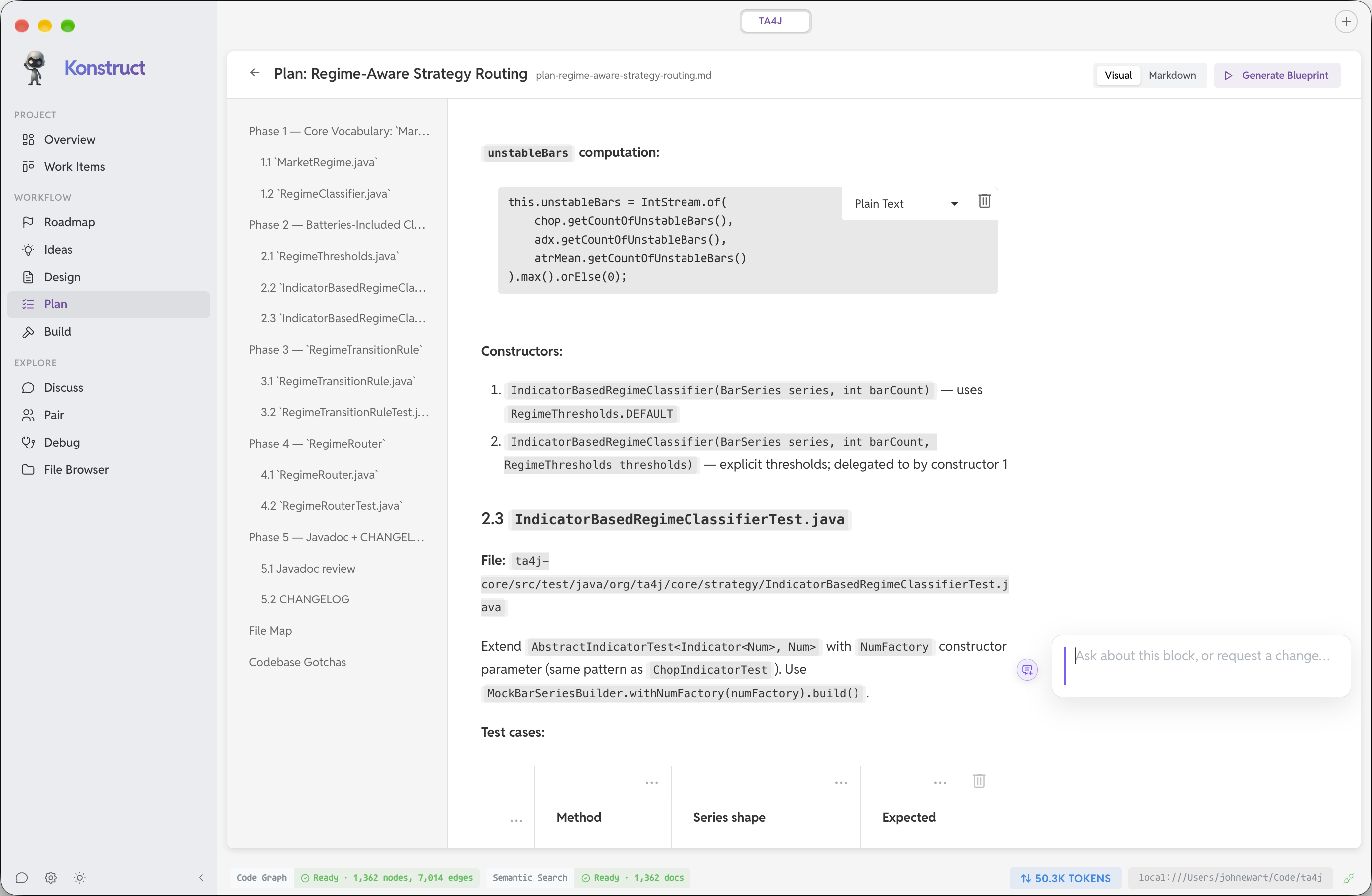
A design describes the destination; it doesn’t know that the thing it wants to extend is used in nine places, three of which are load-bearing. The Plan agent reads your design against your source — using the same code graph the rest of Konstruct runs on — and works out the route.
That means naming the files it expects to touch, the order that keeps the tree working, what the change puts at risk, and the questions worth settling now rather than discovering halfway through. Four questions answered here are four the Build agent doesn’t have to guess at later.
This is worth reading properly rather than skimming. The plan is most of what the Build agent will know about your intentions by the time it starts work, and a wrong assumption left standing here gets implemented faithfully, several phases deep, before anyone notices.
You end up with: an implementation plan written against your files, with its risks and open questions set down in the open.
Give every phase a definition of done
Turn the plan into something a machine can execute and check.
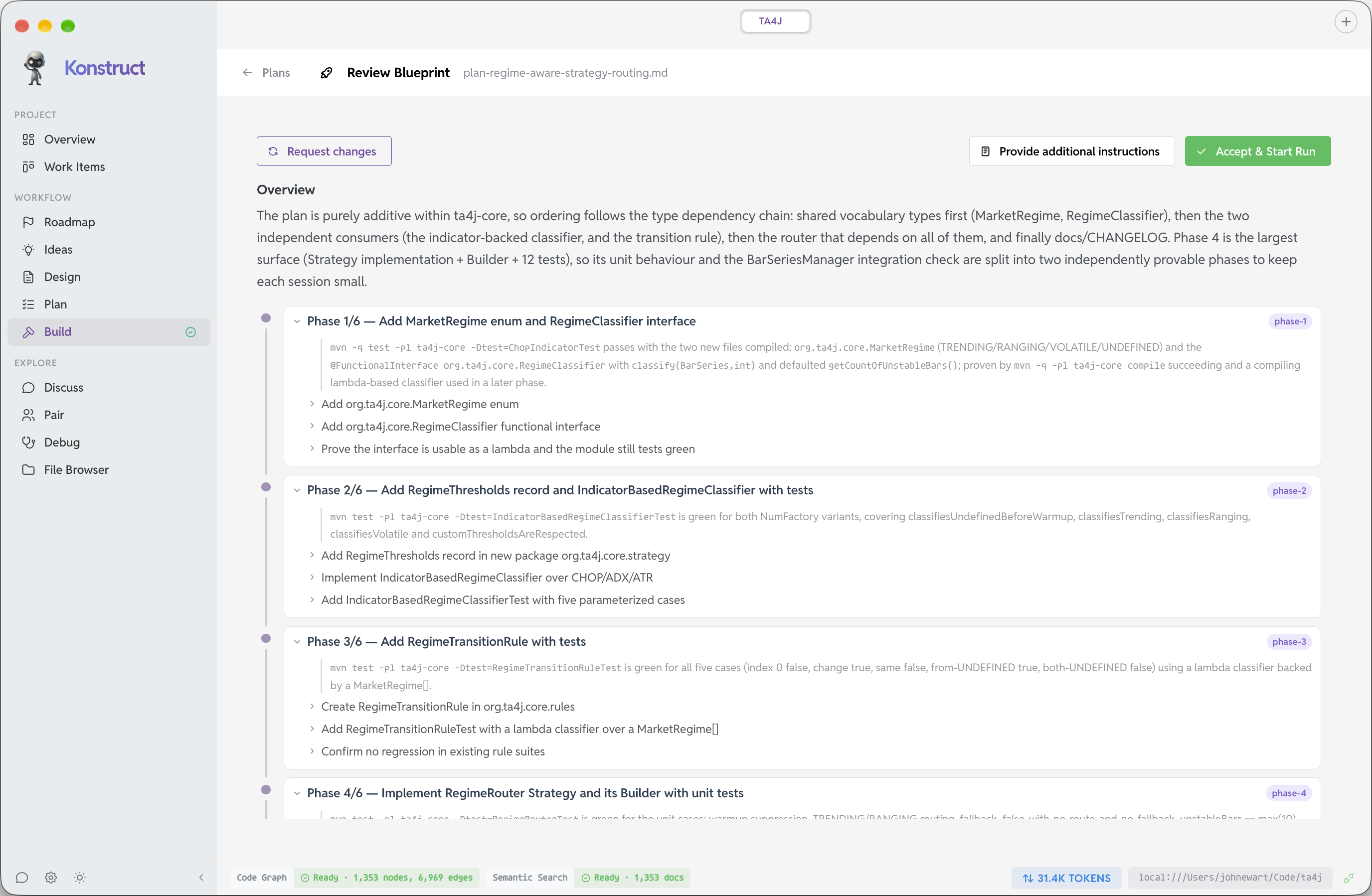
A plan is prose, and prose isn’t executable. The blueprint is that plan compiled into structure: ordered phases, the tasks inside each phase, and a written definition of done attached to every one of them.
Every one of them. Not a heading and a hope that the agent knows what you meant — each phase and each task carries a sentence saying what finishing it looks like, written before any of it runs and specific enough that something other than the agent that did the work can check it: this endpoint returns that shape, these tests run, this old call site is gone.
Those definitions are what the run is checked against. At the end of every phase the finished work is read back — task by task, against what each one was supposed to produce — before anything moves on. A phase that falls short is not marked failed and left behind: the agent is sent back into it with the specific items still outstanding, told what the previous attempt was told, and pointed at anything flagged twice running — so the next attempt fixes the gap rather than repeating the turn that missed it.
When a shortfall survives that — accepted rather than fixed, because the alternative is a run that grinds on one task forever — it is recorded against the phase and carried forward rather than quietly dropped. It turns up in the report at the end, next to the phase that produced it.
The effect is that a mistake gets caught and worked on at the boundary that introduced it, rather than nine phases downstream where nothing is recoverable.
It stays a proposal until you say otherwise, and you can iterate on it. Name a check you want a phase to have to pass. Add a step it missed. Drop a task, split a phase doing too much, tell it to leave the public API alone, tighten a definition of done vague enough to be satisfied by almost anything. It revises the draft each time. A phase gate is only ever as strict as the sentence you gave it, so this is where that gets fixed.
If the shape is wrong rather than the details — the phases carved up along the wrong seams, the ordering built on a bad assumption — you can throw the draft away and have it redrafted from the start, this time with the specific guidance it was missing. That is usually faster than talking a fundamentally wrong plan into being right one correction at a time.
Everything the agent does over the next several hours is set up here, so read the draft properly before you approve it: the order of the phases, what each one claims it will finish, and whether you would accept those definitions as done if someone handed you the result. A blueprint you have actually been through is the single biggest thing you can give the run.
You end up with: an approved blueprint of phases and tasks, each with an explicit definition of done.
Let the Build agent run it
Hand over a feature, not a task.
The Build agent takes the approved blueprint and works it from one end to the other — features, fixes, refactors — clearing each phase’s checks before it moves on to the next. This is work measured in hours, not a single chat turn.
Each phase runs in its own session rather than one enormous conversation stretched over the whole run. A session that has been going for hours is a session whose early instructions have been buried under thousands of lines of tool output — so at every boundary the finished phase is summarized, that session is retired, and the next phase starts fresh, seeded with what the earlier phases established plus its own orientation from the blueprint. The agent gets the distilled version rather than the entire history.
Because the decomposition and the checks already exist, the agent is never improvising about what “done” means. It is working against targets you approved, and saying where it has got to as it goes.
Sometimes the problem is the plan. A phase turns out to depend on something that does not hold, an ordering that looked fine on paper does not survive contact with the code, and the work needs rearranging. That is a legitimate outcome, and it is treated as one: the run says so, loudly, with the phase and the reason attached, rather than improvising a way around it and leaving you to work out later why the thing you approved is not the thing that got built.
You aren’t locked out while that happens. Watch it, redirect it when you spot something going sideways, or stop it outright — the blueprint is still there, and so is everything it finished.
You end up with: the implementation, built phase by phase, with a visible trail of what passed and when.
Audit the results
Assume it did not get everything right, and find out where.
It will not always get the whole task right. That is worth saying plainly, because the failure mode is rarely catastrophe — it is quiet incompleteness. A task gets skipped, an edge case gets stubbed, a criterion gets satisfied in the narrowest possible reading, and the whole thing looks finished from the outside.
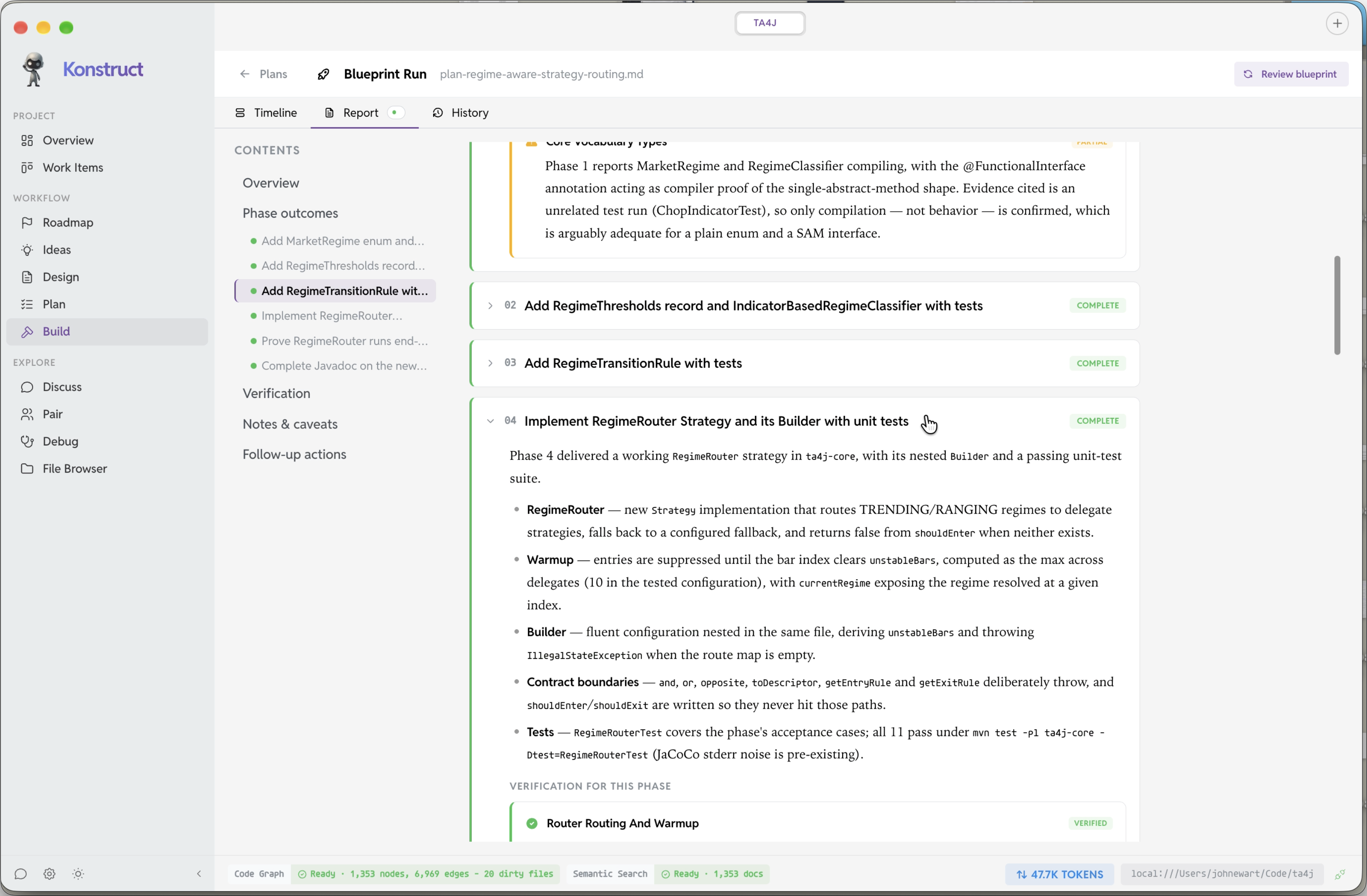
Which is what the report is for. It is not a victory lap — it exists to show you the gaps. A phase that could not satisfy its definition of done is recorded as such at the boundary that produced it, those findings are carried forward rather than forgotten, and the report is assembled on top of that trail: each phase’s verdict, each shortfall, and the files the run actually changed.
So you get what was delivered, what fell short and where, and which follow-ups are worth taking — assembled on top of the run’s own ledger, so a phase’s verdict, an accepted shortfall or a file the run touched still shows up whether or not the closing write-up thought to mention it. The aim was never a run that cannot go wrong. It is a run whose gaps are in front of you at the end, instead of in a merge three days later.
You end up with: a report of what was delivered, what was missed, and what is worth doing next.
Why a run this long holds together
Any agent can be pointed at a big task. The difficulty is the middle of the run — staying on target for hours, not quietly declaring victory, and not silently wedging when something unexpected happens. None of this makes an agent dependable the way a compiler is dependable. It stacks the odds in your favour, and it makes what went wrong visible instead of leaving you to find it. Four things do that work.
-
A structure to execute, not a prompt to interpret
The blueprint is data: ordered phases, tasks with ids, criteria attached to each. The agent is never re-deriving the goal from a paragraph it read an hour ago — the current phase and its definition of done are handed to it directly.
-
An orchestrator, not one long conversation
A separate process advances the run at each boundary: summarize the finished phase, retire that session, start the next one seeded with what came before. Progress is tracked outside the model’s context, so it survives the model losing the thread.
-
Exit gates the agent cannot mark for itself
Saying “phase done” is a request to close a phase, not proof of one. Every finished phase is reviewed by a separate read-only pass, in its own session with no executor history, that opens the changed files and accounts for each task individually.
It closes only on concrete evidence per task; anything less comes back as incomplete with the specific outstanding items. And it fails closed — if that check can’t run, the phase doesn’t pass, because a gate that approves when it can’t verify isn’t a gate.
-
It asks instead of guessing
When the agent hits something it can’t resolve — including a phase of the plan that turns out not to be feasible as written — it stops and says so rather than inventing a way past it. You get the blocker, and you can talk to the agent that hit it — the same session, with the whole phase transcript — instead of briefing a fresh one that wasn’t there.
Answer, and it resumes with your answer. Override and resume anyway. Or read it, think, and leave the run stopped.
Separately, a watchdog checks every thirty seconds that the run is still moving — including the awkward case of a session that claims to be running but has gone silent. A phase that stopped without finishing gets restarted, up to three times. After that, or the moment two attempts come back naming the identical unfinished work, it stops retrying and parks the run as stalled with the reason. It won’t spin on the same wall all night, and it won’t go quiet about having stopped.
What you put in is what you get out
Every step exists to give the next one a better chance, and every step inherits the quality of the one before it. A sharp design gives the plan something real to work from; a specific plan gives the blueprint phases worth gating; a blueprint whose phases say plainly what passing means is what the Build agent spends its hours satisfying. The reverse is just as true, which is why all three are yours to change before anything runs — and why the run ends with a report on where it fell short rather than a claim that it didn’t.